Going to the Party
 Sophie Katz continues the discussion about new parties on the left.
It’s easy to make mistakes in Britain about new parties. To my reckoning there have been/are at least 5 such efforts set up in the last 17 years. Nobody has properly documented this experience so far. Everybody on the far left (which now includes the British CP) has been convinced that their version holds the magic formula (correct leadership; proper analysis; or simple sectarian blindness to the fact that their efforts are not the first such attempt; that they did not invent the idea.) Also, there is a belief that somehow putting the word ‘mass’ in front of the ‘new party’ is enough to protect against the far left’s traditional and pervading vice of sectarianism.
The heart of the matter is that the far left’s analysis of society, of the world, rarely extends to themselves and their own doings. All agree that social democracy has definitively moved to the right. (There are various versions of this that need not detain us here.) Ergo the vacuum left behind will suck up (something) to fill the gap. Now we also have a major economic crisis of the system. And that’s about as far as the analysis goes. Sadly the vacuum has proved less accommodating than might have been hoped; – which may have had a little to do with the very long and far from ideal experiences that many active working class people have had with the far left. The battle over the crisis in Britain has started – with some important consequences – but not in the direction of any substantial political regroupment.
Take a step or two back. Genuine mass parties of the working class movement have been formed, by and large, around massive movements in and among subordinate classes – mainly in the direction of huge increases in self-organisation at the social and economic level. The big expansion of the British trade union movement in the 1880s into the semi-skilled and unskilled sectors presaged the formation of the Labour Representation Committee. Similarly, Russian Social Democracy, both factions, ballooned when hundreds of thousands of peasants were drafted into the cities to staff the biggest factories in the world and created unions and then organised to save their lives in the desperately poorly managed Russian Army. The exception to this pattern is of course the success of the Russian revolution. This indeed created mass parties and split others right across the globe. It was however a world shattering event immediately following the catastrophe of world war. Even then in Britain it produced the barely formed infant of the European communist family.
But what about the new modern European parties of the left that have been developing over the last 25 years? These emerged as a rupture from, but also as a continuity of, genuine mass far left traditions in those countries. This was mostly a communist party movement that had been flirting with power over decades. With the collapse of the USSR the healthier parts of that tradition (and its ‘opposite’ which also defined it, including some Trotskyists, etc) formed sufficiently strong nuclei to align themselves with the new social movements (anti-war, ecology etc) in a credible way. They had a critical mass that could attract generally radicalising forces that were fighting aspects of the system. And they were seen as a legitimate part of an already existing political culture, albeit recomposed by a rejection of Stalinism, by working class and other radical forces in those countries.
Neither determining condition has applied in Britain. Instead various efforts have been made to ‘leap over’ these facts about the salient material and political forces that exist in Britain and instead an act of will and a strong enough desire has been substituted – in the best traditions of messrs Healey et al.
So what’s to discuss?
A lot really. For example the British trade union movement maybe a shadow of its former self but a type of dual power is emerging as Milliband puts pressure for it to line up behind his version of austerity on the one hand, and on the other, those unions emerging, now led by UNITE, that wish to take national and coordinated action against ALL austerity – and through instruments like the charter and the NICE are developing an alternative policy. There are two distinct poles in the modern TUC. This is a potential seismic shift among organised workers. It has much larger import (because it contests, frontally, for leadership) than the remnants of the Benn/Scargill wing of the labour movement had in the 1990s, which was then the material and political premise for the foundation of the SLP.
The disassociation from the political system in Britain by the bulk of the working class leads to radical and dramatic actions that genuinely leap over all the traditions of labourism, including not-missed resolutionary socialism, viz., Lewisham – activists and workers forming new alliances based on action reaching widely into different social layers. Formations like CoR are based politically on such independent developments. (A minor aspect of the working class disassociation with the political system is – all proportions guarded – the parallel internal dislocation of significant bits of the far left groups and organisations as remaining militants become jaundiced by their regimes, ineffectiveness, pretensions and sectarianism.)
Finally some new think-tanks and a (small) avalanche of books announce an intellectual stirring around non social democratic working class politics. A significant international debate about a new communism has erupted, led by Zizeck, Badiou, Jodi Dean and a clutch of Italian professors. There is a genuine excitement about a renovated communist project for radical change.
These elements and others incline to come together in the British context. But at the moment a party, when you cannot make any sort of contest for power, seems like a pre-ordained mantra emerging from an office in North London rather than a forward looking expression of the actual state of the debate and the lay of the land. And we all know that all of these elements, and their intentions towards unity, will flourish or shrivel dependent on the absolutely fundamental social and political battle with austerity. That struggle will provide the ocean on which any major political regroupment will sink or float.
Left Unity is active in movements and campaigns across the left, working to create an alternative to the main political parties.
About Left Unity
Read our manifesto
Left Unity is a member of the European Left Party. 
Read the European Left Manifesto
ACTIVIST CALENDAR
Events and protests from around the movement, and local Left Unity meetings.
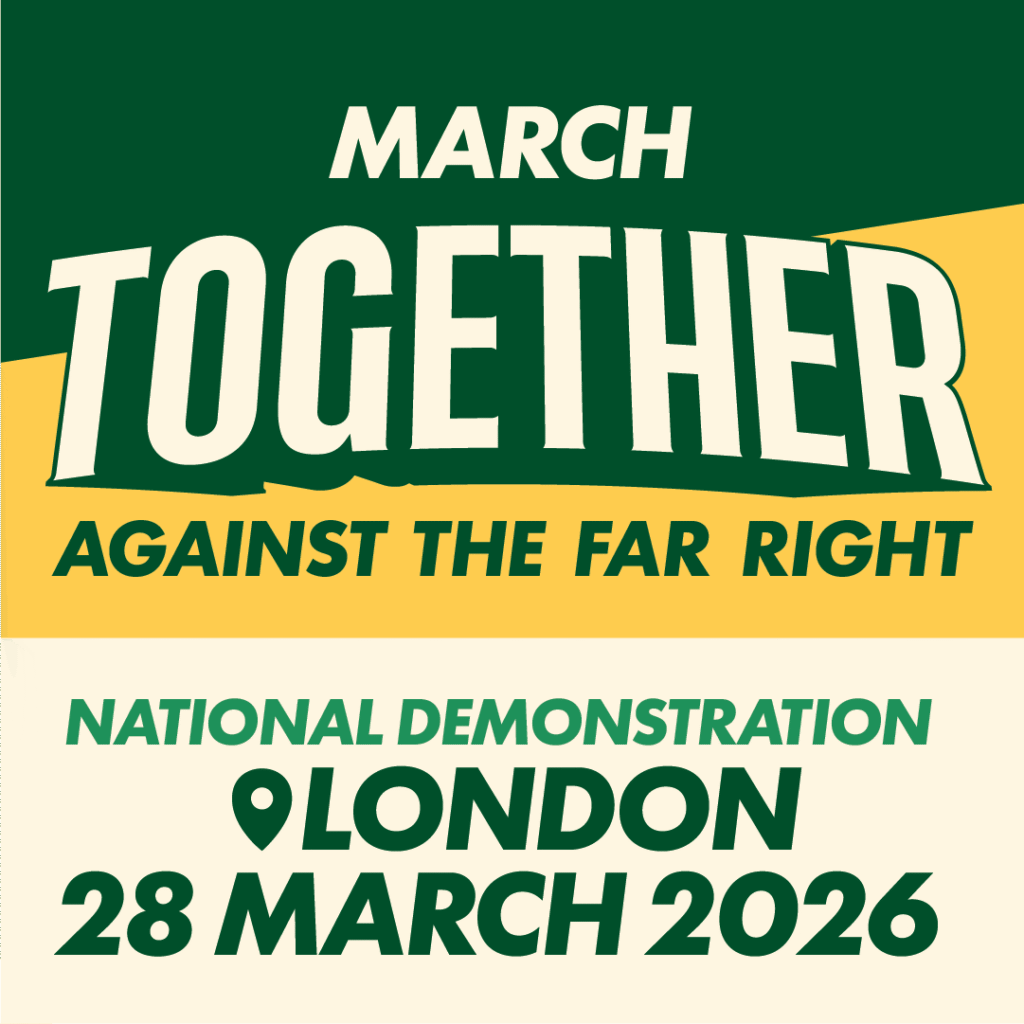
Saturday 28th March: March Together against the Far Right
Assemble central London 12 noon
More events »
GET UPDATES
Sign up to the Left Unity email newsletter.
CAMPAIGNING MATERIALS
Get the latest Left Unity resources.